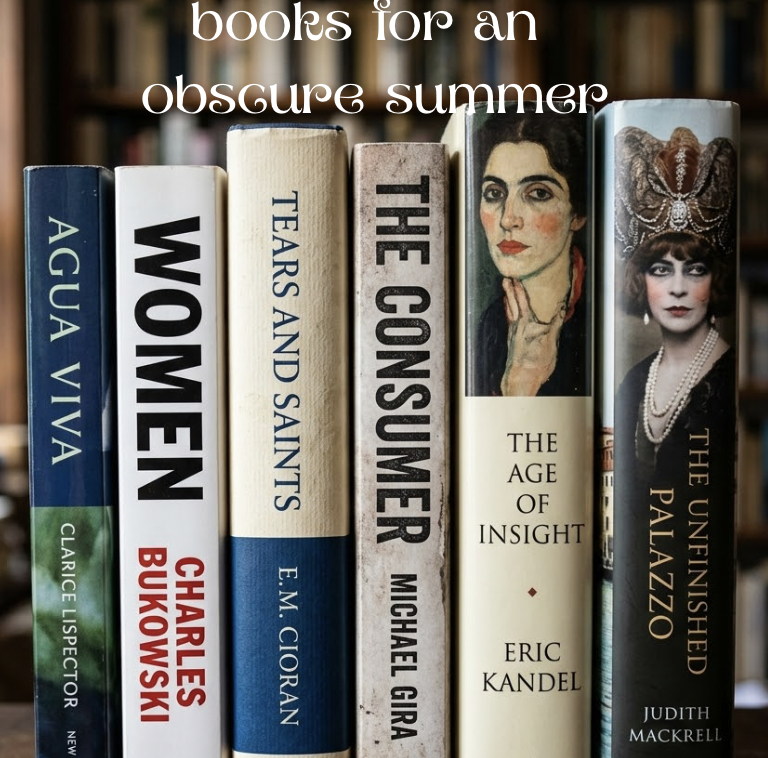
Most reading lists follow a tidy, predictable script: classic works grouped by genre, literary awards, or historical eras. But our actual reading lives rarely unfold so neatly. We often find solace in the obscure, the uncomfortable, or the wildly unconventional, books that don’t fit neatly into standard categories, yet meet us at precise moments when we need them most. Inspired by Heaven Sent Honey’s reflection on her hidden bookshelf, this collection explores six eclectic titles that span the full spectrum of human experience, from delicate existential joy to the dark underbelly of human nature.
If you have ever felt overwhelmed by the sheer intensity of being alive, Clarice Lispector’s stream-of-consciousness novella Água Viva offers a rare form of communion. Plotless and fluid, the book acts like a fountain of raw thought, written as if Lispector were capturing the fleeting nature of reality directly at her typewriter. Lispector excels at taking the mundane, a dying rose, a mirror hanging in an empty room, and transforming it into something luminous and strange. In one famous passage, she compares the difficulty of surrendering to the present moment to holding a trembling bird in a half-closed hand, a moment so fragile and intimate that we feel compelled to open our palm and set it free. This book is ideal for readers seeking poetic introspection, aesthetic beauty, and existential clarity.
Moving from Lispector’s delicate lyricism to Charles Bukowski is a deliberate shock to the system. Known for his stark, unvarnished, and often abrasive prose, Bukowski’s semi-autobiographical novel Women documents a period of late-life success amidst his chaotic habits. While Bukowski’s work can be polarizing, his appeal often lies in his utter refusal to romanticize life. When you are overwhelmed or taking life too seriously, his plain-spoken, cynical humor strips away pretension, offering a bizarre form of grounding comfort for those looking for raw, unpolished realism and irreverent humor.
Romanian philosopher Emil Cioran is famous for his dark, nihilistic outlook, yet in Tears and Saints, his examination of martyrdom and religious fervor reads less like a dry treatise and more like a collection of sharp, rhythmic aphorisms. Cioran explores how saints and mystics, such as St. Rose of Lima, used extreme physical suffering and sleep deprivation to achieve a heightened, mystical state of awareness. To Cioran, saintliness is a conscious effort towards winning everything through holy madness, using pain to intensify human subjectivity and transcend the mundane world, making it a compelling read for enthusiasts of philosophy, aphoristic writing, and dark historical studies.
For those drawn to the grotesque, The Consumer, a rare collection of short stories by Swans frontman Michael Gira, delves directly into human cruelty and horror. Unlike fantasy horror, Gira’s writing mirrors the shocking, raw headlines of real-world crime and psychological breakdown. It is an uncomfortable read, but it serves a specific psychological purpose: by confronting the darkest corners of human nature head-on, the shock transforms into a strange, sobering sense of awe regarding what humans are capable of. It stands out as an intense choice for fans of dark fiction, body horror, and uncompromising transgressive literature.
Stepping back into the light, Nobel laureate Eric Kandel’s The Age of Insight examines turn-of-the-century Vienna, where artists, psychoanalysts, and neuroscientists mingled in salon culture. Kandel breaks down how groundbreaking artists like Gustav Klimt, Egon Schiele, and Oskar Kokoschka subconsciously integrated early biological and psychological insights into their portraiture. Klimt incorporated motifs resembling human egg and sperm cells into decorative patterns, Schiele used exaggerated, tense line work and feverish skin tones to reflect personal trauma and anxiety, while Kokoschka captured psychological depth so intensely that his portraits seemed to predict physical ailments before they manifested. It provides a fascinating journey for art history lovers, science enthusiasts, and anyone curious about how the human brain perceives art.
Ending on a grand, dramatic note, Judith Mackrell’s The Unfinished Palazzo tells the history of Venice’s iconic Palazzo Venier dei Leoni, now the Peggy Guggenheim Collection, through the lives of the three eccentric women who inhabited it. It traces the life of Marchesa Luisa Casati, a flamboyant dandy who famously declared she wanted to make her life a living work of art and was known for walking veiled through Venice at night with cheetahs on leashes. It then moves to Doris Castlerosse, an English socialite who redecorated the palazzo into a gilded retreat during the 1930s, and culminates with Peggy Guggenheim, the legendary art collector who transformed the space into a sanctuary for modern art. It is a brilliant tribute for lovers of biography, Venetian history, and grand, artistic lifestyles.
Leave a Reply