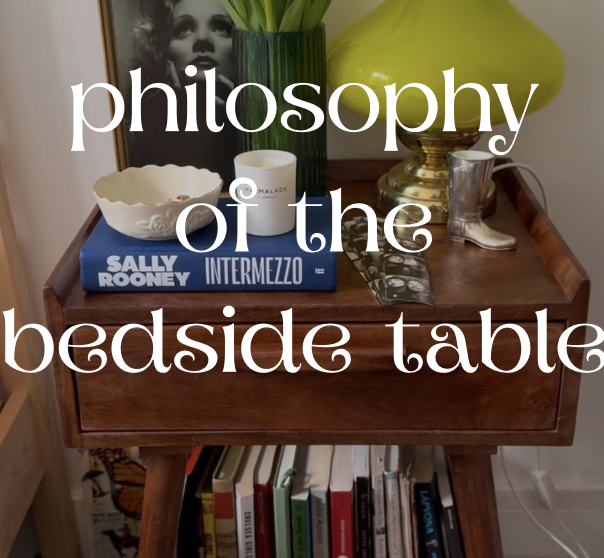
We live in a culture that demands constant visibility. We document our routines, broadcast our thoughts, and curate our public-facing lives for an endlessly scrolling audience. Yet, tucked away in the quietest corner of our bedrooms sits a small, unassuming surface that holds our most honest story: the bedside table. From old internet mood boards to modern digital essays, images of nightstands, a stack of paperbacks, a half-burned candle, a tangled chain, or a glowing screen: have quietly remained one of our most enduring cultural visual tropes. We are perpetually captivated by these small clusters of everyday clutter because the bedside table is never just a piece of furniture. It is a personal altar.
Historically, the bedroom, and specifically the boudoir, has served as a sanctuary of retreat. It functions much like an interior womb: a dark, enclosed, protective space where ideas, rest, and identities incubate away from the gaze of the world. If the bedroom is a sacred shrine, then the nightstand is its altar, the exact surface where we conduct our quietest nightly and morning acts of devotion. It is where we unclasp our jewelry, set down our reading glasses, sip water before sleep, and extinguish the light. In a world where living spaces are shrinking and shared apartments blend our public and private lives, that tiny square footage next to the mattress often becomes the only space that belongs entirely to us.
What makes the nightstand unique is its delicate balance between deliberate intention and pure accident. On one hand, we consciously choose what belongs there: a reading lamp, an alarm clock, or a favorite hand cream. On the other hand, it naturally accumulates the stray debris of our daily existence: a loose pearl found on an afternoon walk, a lingering ticket stub, a spent match, or a dried flower stem. These objects are not mere junk, but physical extensions of ourselves. They form a quiet, intimate still-life that constantly reaffirms who we are when nobody is watching. The objects on your nightstand maintain your identity and your belief in yourself, reminding you of your true nature in the stillness of the night.
If our personal possessions are physical manifestations of our internal state, then observing your bedside table becomes a form of everyday divination. Looking closely at its surface reveals where you have been and where you might be going. A stack of history books and a vintage key might suggest a deep desire to return to origins and seek underlying meaning, while a tangle of charging cords and half-empty cups reflects a mind running on anxiety and burning out. Keepsakes from past trips or family heirlooms reveal an impulse to anchor oneself to memory during moments of transition. When you look closely at these scattered relics, you are not just looking at random items you own; you are looking at fragments of your own psyche left behind in the dark.
Because your nightstand influences your frame of mind every morning when you open your eyes and every evening before you drift off, treating it with intentional care becomes a subtle form of self-preservation. Clearing away stray trash, old receipts, or items that carry heavy, unwanted energy allows space for objects that genuinely support your daily acts of grounding. By leaving a small cushion of space for chance, you allow the room for those random, beautiful fragments that naturally slip out of your pockets at the end of the day to land where they belong. The next time you feel lost, overwhelmed, or disconnected from yourself, you do not need to look far. Look to the small ledge beside your pillow, where the answers to who you are, and who you are becoming, are already resting.
@signedpaula
Leave a Reply