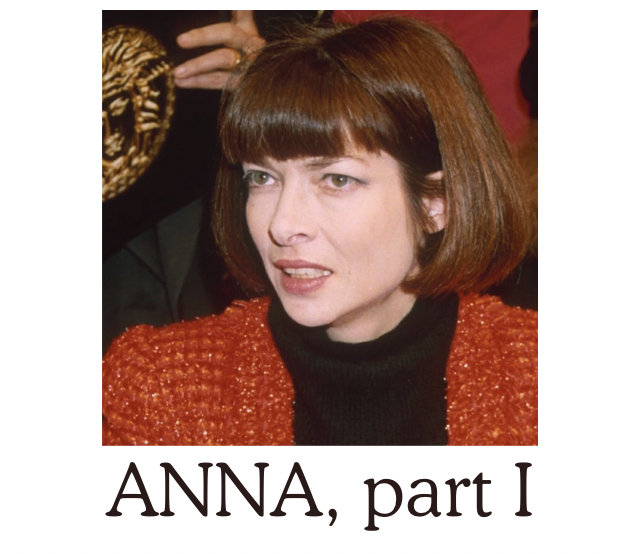
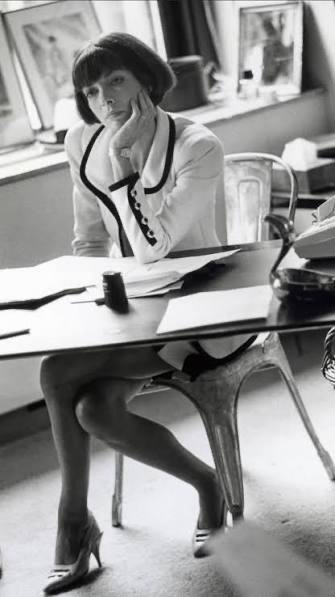
A young Anna Wintour in her signature sharp bob. SOURCE: Images Press / Getty Images
To understand Anna’s leadership style, one has to look directly at her father, Charles Wintour, the legendary editor of London’s Evening Standard. Known across Fleet Street as Chilly Charlie, he was a formidable media executive who commanded equal parts terror and devotion. From Charles, Anna absorbed two foundational lessons that would come to define her entire tenure at Vogue.
First was the high low editorial formula. Charles famously believed that a great newspaper needed a headless corpse on the front page, paired with an article inside that the Permanent Undersecretary at the Treasury could not afford to miss. Decades later, Anna applied this exact framework to fashion, seamlessly pairing ten thousand dollar haute couture pieces with accessible blue jeans and pop culture icons. Second was stoicism as a core survival mechanism. Following the tragic loss of her older brother Gerald in a road accident in 1951, the Wintour household buried their grief beneath an unyielding work ethic. Charles went straight back to his desk the very same day. When Anna famously broke down in front of her staff following the 2016 election, a rare moment her team dubbed the crackle, it shocked everyone precisely because her emotional armor had remained impenetrable for over thirty years.
Anna’s entry into fashion was never marked by academic prestige. While her siblings pursued high level intellectual paths at prestigious universities, Anna dropped out of North London Collegiate at sixteen to dive headfirst into the epicenter of 1960s London culture, shopping at Biba, frequenting clubs like Dolly’s, and observing street style. Her early career was a masterclass in trial, error, and industry friction. She learned retail dynamics from the ground up at Biba and Harrods’ Way In, debuting on the masthead of Harpers and Queen in 1970 as a fashion assistant. It was there that she began perfecting her signature high low styling, famously pairing a nineteen hundred pound white fox coat with a twenty nine pound Biba chair, while mastering the exhausting mechanics of photo shoots. When she was passed over for the fashion editor role in favor of interior expert Min Hogg, Anna refused to stay subservient to someone whose aesthetic she did not respect, resigning in total solidarity with her own creative standards.
Moving to Manhattan in 1975 without a guaranteed job, Anna quickly discovered that American publishing operated under a completely different set of rules. Hired as a junior sittings editor at Harper’s Bazaar, she immediately collided with editor in chief Tony Mazzola. Where Mazzola favored traditional, highly commercialized layouts, Anna demanded edge, surrealism, and high fashion. After bringing back a Paris shoot featuring models with cornrows and provocative lighting, Mazzola fired her for being too European and uncommercial. Instead of curbing her instincts, the firing taught her a vital lesson, which was to never shrink her editorial vision to fit a cautious institution.
Her next move was to Viva, an erotic women’s magazine published by Penthouse founder Bob Guccione. While the publication carried a taboo reputation, it offered Anna something priceless, which was total creative freedom and a bottomless budget. She flatly refused to use in house centerfold models, insisting on high fashion agency talent instead, while collaborating with boundary pushing creators like Jean Paul Goude and Arthur Elgort. During this time, she learned how to navigate difficult, eccentric owners while building serious commercial leverage through advertiser relationships.
By the time she joined New York Magazine in 1981 under Ed Kosner, Anna was no longer just an editor carrying clothes on set, but a visionary auteur. Recognizing that traditional fashion shoots were becoming predictable, she brought in art world figures to collaborate on set, staged models on rooftops with skewed perspectives like her famous In the Heat of the Night spread with Andie MacDowell, and introduced high octane luxury to a news driven readership. Kosner gave her the budget and freedom her previous bosses had withheld. Her workstation, a pristine white Parsons table surrounded by dynamic mood boards, became her personal command center.
Looking back at the first act of Anna Wintour’s life, her ascent was far from a simple linear fairy tale. It was a calculated series of sharp turns, public setbacks, and unwavering self assurance. Her trajectory demonstrates that clarity always beats consensus, as she never polled the room or waited for permission to make a visual statement. She spent decades quietly cultivating a network of young photographers, stylists, and designers who shared her standard of excellence, proving that getting fired from a top publication does not mean your taste is wrong, but simply that you haven’t yet built the platform that matches it.
Leave a Reply